
Who Is the 16th President of America? Abraham Lincoln was a key figure in US History. He was the 16th President of the United States. His leadership during a time of great turmoil has left a lasting legacy in American politics.
Lincoln’s commitment to preserving the Union and ending the injustice of slavery has made him an iconic figure in American History. As you explore his life and presidency, you’ll gain insight into the challenges he faced and the decisions that shaped the nation.
As the American President during the Civil War, Lincoln’s strong leadership and eloquence in speech, as seen in his Gettysburg Address, continue to inspire Americans today. His historical significance extends beyond his presidency, representing the principles of liberty and equality.
Contents
- 1 The Early Years of Abraham Lincoln
- 2 Lincoln’s Path to Politics
- 3 Who Is the 16th President of America?
- 4 Leading a Nation Divided: The Civil War Years
- 5 Lincoln’s Fight Against Slavery
- 6 The Personal Side of President Lincoln
- 7 Second Term and Vision for Reconstruction
- 8 The Assassination and Its Aftermath
- 9 Conclusion: Who Is the 16th President of America?
- 10 FAQ
- 10.1 Who was the 16th President of the United States?
- 10.2 What were Abraham Lincoln’s views on slavery?
- 10.3 What was the significance of the Emancipation Proclamation?
- 10.4 What were some of the major challenges Abraham Lincoln faced during his presidency?
- 10.5 How did Abraham Lincoln’s leadership style contribute to his success?
- 10.6 What was Abraham Lincoln’s vision for Reconstruction after the Civil War?
- 10.7 How is Abraham Lincoln remembered today?
The Early Years of Abraham Lincoln
Abraham Lincoln’s early life was tough. He was born on February 12, 1809, in a log cabin in Kentucky. His childhood was poor and he didn’t get much formal education. But his love for reading grew thanks to his mother, Nancy Lincoln.
Lincoln grew up in rural Kentucky and later in Indiana. His family, led by his father, Thomas Lincoln, a farmer and carpenter, moved often. They searched for better lives. When Lincoln was nine, his mother, Nancy, passed away. His stepmother, Sarah Bush Johnston, then encouraged his reading.
Lincoln only got a year of formal education. But he read a lot, teaching himself. This self-education was key to his future. As you delve into Lincoln’s biography, you’ll see how his early life shaped his later years.
| Year | Event | Location |
|---|---|---|
| 1809 | Born in a log cabin | Kentucky |
| 1816 | Family moved to Indiana | Indiana |
| 1818 | Mother’s death | Indiana |
Despite facing poverty and limited education, Lincoln didn’t give up. These challenges made him work hard and aim high. As you learn more about Lincoln, you’ll see how his early struggles influenced his presidency and legacy.
Lincoln’s Path to Politics
Exploring Lincoln’s life shows how his early experiences shaped his political career. He joined the Whig Party, which pushed for modernization and economic growth. This early choice set the stage for his political journey.
Lincoln’s early politics were influenced by his young life. He worked as a store clerk and got involved in local politics. He served in the Illinois state legislature from 1834 to 1842. There, he became known for supporting infrastructure and education.
In the 1840s, Lincoln’s career took off. He was elected to the U.S. House of Representatives. He spoke against the Mexican-American War and pushed for internal improvements. His ties to the Whig Party continued to guide his views.
His debates with Stephen Douglas in 1858 were key moments. Even though he lost the Senate race, these debates made him famous. They prepared him for his future presidential runs.
Lincoln’s growth as a politician was remarkable. He adapted to changes and stayed true to his values. His Lincoln’s Political Career soared, thanks to his early politics and the Whig Party.
Who Is the 16th President of America?
You might know Abraham Lincoln was the 16th President. But, his presidency shows how much he changed America. His election in 1860 was a big deal, changing the U.S. politics.
As the 16th President, Lincoln had to keep the Union together during the Civil War. He stood strong for freedom and equality. [Who Is the 16th President of America?]
Lincoln’s time in office was tough. He had to make hard choices for a country divided. One big move was the Emancipation Proclamation, freeing slaves in Confederate areas.
Lincoln was great at talking to the people. His speeches, like the Gettysburg Address, are still famous. They show what America values. [Who Is the 16th President of America?]
Lincoln’s impact goes beyond his time in office. He’s still seen as a leader and a symbol of integrity. His legacy as the 16th President still shapes America today.
Looking at Abraham Lincoln’s Presidency, it’s clear he was more than just a title. He was a key moment in American history that still matters today.
Leading a Nation Divided: The Civil War Years
The Civil War was a huge challenge for Lincoln. He had to make tough choices that would shape the nation’s future. He faced the hard task of leading the Union through the war.
Lincoln’s relationships with his generals were key to winning the war. He worked closely with Ulysses S. Grant and George McClellan, despite their disagreements.
Relationships with Union Generals
Lincoln showed great skill in leading the military. His trust in Ulysses S. Grant was crucial. Grant’s victories in the West helped the Union.
Key Military Decisions
Lincoln made important military decisions. One big one was the Emancipation Proclamation. It changed the war’s goal to include ending slavery. [Who Is the 16th President of America?]
The war’s progress and Lincoln’s leadership are shown in key battles. Here’s a table of some important events:
| Event | Date | Outcome |
|---|---|---|
| Battle of Gettysburg | July 1-3, 1863 | Union victory |
| Emancipation Proclamation | January 1, 1863 | Freed slaves in Confederate territory |
| Battle of Vicksburg | May 18-July 4, 1863 | Union victory, split the Confederacy |
Lincoln’s leadership during the Civil War was crucial. He worked hard to keep the Union together. His strategic decisions helped the Union win the war.
Lincoln’s Fight Against Slavery
As the 16th President of the United States, Lincoln faced a big challenge. He had to fight against slavery, both morally and politically. You might wonder how his leadership during this time changed the nation’s view on slavery.
Lincoln’s fight against slavery started slowly. At first, he wanted to stop slavery from spreading, not to end it right away. But as the Civil War went on, he saw ending slavery as a must. He believed it would hurt the Confederacy’s war efforts.
The Emancipation Proclamation, issued on January 1, 1863, was a key moment in Lincoln’s fight. It made all slaves in rebel states free, starting right then. But it didn’t cover border states or areas under Union control. This showed the tricky politics behind Lincoln’s decisions.
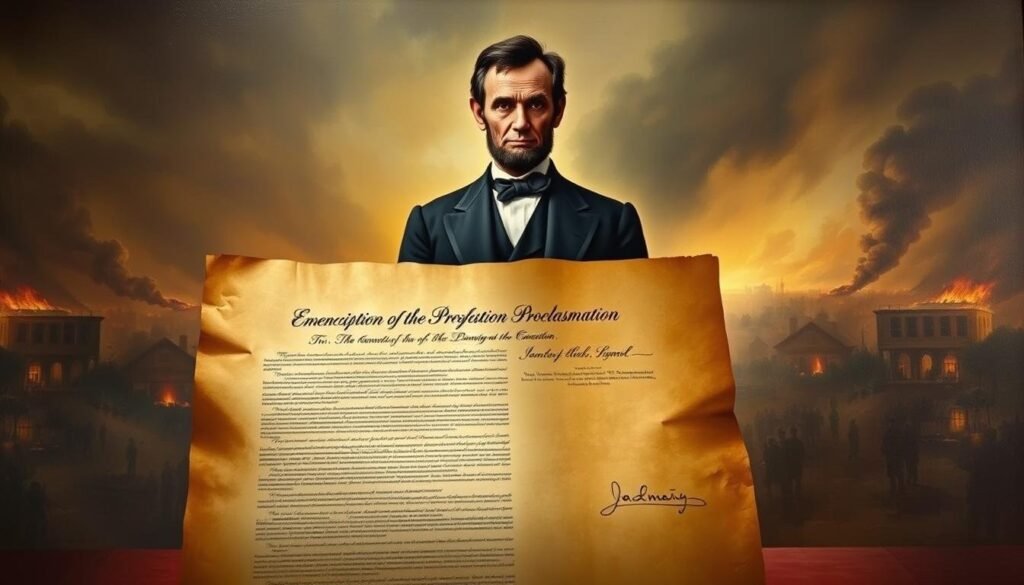
The Emancipation Proclamation was more than a moral statement. It was a smart move to weaken the Confederacy and boost the Union’s moral stance. This shift helped change public opinion and paved the way for the 13th Amendment in 1865.
Lincoln’s battle against slavery was tough. He faced opposition from his own party and border states. Yet, he stayed true to his dream of a slave-free America. He set the stage for a more united nation. [Who Is the 16th President of America?]
In conclusion, Lincoln’s views on slavery changed a lot during his time in office. The Emancipation Proclamation was a key step towards ending slavery. His leadership during this time changed the Civil War’s course and left a lasting mark on American history.
The Personal Side of President Lincoln
Exploring Lincoln’s personal life reveals a complex individual. His family life and relationships deeply influenced his work. He married Mary Todd Lincoln in 1842, creating a mix of love, politics, and tragedy.
The Lincolns had four children, but only one son, Robert Todd Lincoln, lived to adulthood. The loss of their children deeply affected both Lincoln and his wife. Their family life was filled with both joy and sorrow, shaping Lincoln’s character and informing his decisions as president.
Mary Todd Lincoln was more than just a supportive spouse. She was a partner who shared his interests in politics and social issues. Her family background also influenced Lincoln’s political career. [Who Is the 16th President of America?]
| Family Member | Relation to Lincoln | Notable Facts |
|---|---|---|
| Mary Todd Lincoln | Wife | Member of a prominent Kentucky family, influential in Lincoln’s political life |
| Robert Todd Lincoln | Son | Survived to adulthood, served as U.S. Ambassador to the United Kingdom |
| Edward Baker Lincoln | Son | Died in childhood |
Lincoln’s commitment to his family was clear, even as he faced presidential challenges. His personal experiences and relationships humanize him. They offer a deeper understanding of his leadership during a pivotal time in American history.
Second Term and Vision for Reconstruction
After winning re-election in 1864, Lincoln focused on Reconstruction. The Civil War was ending, and he aimed to rebuild the nation. He wanted to bring the Southern states back into the Union.
Lincoln’s vision for Reconstruction was about forgiveness and coming together. He proposed the 10% Plan. This plan said that 10% of voters in the Confederate states had to pledge loyalty to the Union. They also had to agree to end slavery before a state could be re-established.
The table below outlines the key components of Lincoln’s Reconstruction plan and their significance:
| Component | Description | Significance |
|---|---|---|
| 10% Plan | Required 10% of voters to pledge loyalty | Facilitated quick re-entry of Southern states |
| Abolition of Slavery | Condition for re-entry into the Union | Ensured end of slavery across the United States |
| Reconstruction Proclamation | Outlined terms for readmission | Set precedent for future Reconstruction policies |
Lincoln’s vision after the war was not just about fixing buildings. It was about healing the nation’s wounds. His commitment to a unified America was clear in his Reconstruction plans. These plans aimed to unite the country after years of division.
The Assassination and Its Aftermath
As the Civil War ended, a dark plot unfolded. It led to the death of President Lincoln. On April 14, 1865, John Wilkes Booth, a Confederate supporter and actor, shot Lincoln at Ford’s Theatre in Washington, D.C.
The news shocked the nation. Lincoln’s assassination was a personal and national tragedy. It left the country in deep sorrow. [Who Is the 16th President of America?]
After Lincoln’s death, Vice President Andrew Johnson took over. He had to carry on Lincoln’s plans for Reconstruction. But Johnson’s way was different, leading to a more challenging time in American history.
The search for John Wilkes Booth was huge. Booth was found and killed by Union soldiers on April 26, 1865, in Virginia. His accomplices were also hunted down, with some being executed for their part in the assassination.
Lincoln’s death greatly affected Reconstruction. Without him, the effort became more difficult. Radical Republicans wanted harsher actions against the South. This time was filled with political fights and social changes.
Lincoln’s legacy kept shaping America. His fight to keep the Union together and end slavery was a powerful symbol. The nation struggled with the effects of his death, trying to complete the unfinished work of Reconstruction.
Conclusion: Who Is the 16th President of America?
You’ve learned about Abraham Lincoln, the 16th U.S. President. His life and presidency have greatly shaped America. His fight to keep the Union together and end slavery shows the true American spirit.
Lincoln’s leadership during the Civil War and his famous speeches, like the Gettysburg Address, are unforgettable. His words and actions have left a lasting mark on American history. His beliefs in freedom, equality, and unity are still important today.
Reflecting on Lincoln’s presidency, you see his strong moral compass and leadership. He showed us the value of standing up for what’s right, even when it’s hard. His legacy reminds us of the importance of doing what’s right, no matter the challenge.
Today, Lincoln’s impact on American society is celebrated and studied. His life and presidency are a key part of America’s cultural heritage. His story and values continue to inspire us all.
See Also: Who Is the First Black President in USA? Key Facts
FAQ
Who was the 16th President of the United States?
Abraham Lincoln was the 16th President of the United States. He served from 1861 until his death in 1865.
What were Abraham Lincoln’s views on slavery?
Abraham Lincoln opposed the growth of slavery. He issued the Emancipation Proclamation in 1863. This declared freedom for all slaves in Confederate territory.
What was the significance of the Emancipation Proclamation?
The Emancipation Proclamation was a big step towards ending slavery in the U.S. It helped pave the way for the abolition of slavery with the 13th Amendment. [Who Is the 16th President of America?]
What were some of the major challenges Abraham Lincoln faced during his presidency?
Abraham Lincoln had to keep the Union together during the Civil War. He also had to deal with military strategy and making important decisions for the Union army.
How did Abraham Lincoln’s leadership style contribute to his success?
Lincoln’s strong leadership and commitment to his values helped him succeed. He was great at communicating with the American people, which aided him in his presidency.
What was Abraham Lincoln’s vision for Reconstruction after the Civil War?
Lincoln wanted to reunite the country and protect the rights of freed slaves. His plans for Reconstruction were cut short by his assassination. [Who Is the 16th President of America?]
How is Abraham Lincoln remembered today?
Abraham Lincoln is seen as a key figure in American history. He is celebrated for his leadership during the Civil War and his fight against slavery. His legacy as a symbol of American values endures.

Hi, I am Tatum Bradford from Washington. I have a background in political science and work as a senior revenue officer. I love learning about U.S. presidents and sharing interesting facts about political history.